The most reliable way to potty train a puppy is to pair a predictable, age-adjusted schedule with close supervision, crate use, and immediate rewards the moment your puppy goes in the right spot. Most puppies get the basics down within a few weeks and become consistently reliable somewhere between four and six months. You will lean on a timer, a properly sized crate, and an enzymatic cleaner more than any gadget or gimmick.
TL;DR:
- Most puppies become reliably house-trained between four and six months old with consistent scheduling, supervision, and positive reinforcement.
- The 10-10-10 routine structures critical potty times by giving puppies 10 minutes outside in a designated spot, up to 10 tries, and 10 minutes of indoor supervision.
- Using a crate that fits comfortably and practicing the umbilical-cord method helps prevent accidents by keeping puppies close during unsupervised times.
- Enzymatic cleaners effectively eliminate odor traces that encourage repeat soiling, supported by research linking proper cleanup with higher success.
- Socialization before 20 weeks and ongoing class exposure improve house-training progress and help puppies develop calm, routine behaviors.
Table of Contents
- Building a Daily Potty Schedule With the 10-10-10 Routine
- Supervision, Crate Training, and the Umbilical-Cord Method
- Teaching a Cue and Rewarding Success
- Cleaning Accidents and Fixing Common Setbacks
- The Role of Puppy Classes and Socialization
- When to Call a Veterinarian or Behavior Professional
- What the Research Actually Supports
- A Few Honest Words on Patience
- Quick Links: Research and Printable Schedules
- Sources
- FAQ
Building a Daily Potty Schedule With the 10-10-10 Routine
A young puppy’s bladder control roughly follows a simple rule: age in months plus one hour is about how long they can hold it during the day. A 2-month-old puppy needs a bathroom trip every hour or two, while a 5-month-old can often stretch to four hours. Trainers and shelters have long used printable schedules built around this guideline because it turns a vague goal into a concrete plan.
Your puppy needs a trip outside at every one of these trigger moments:
- Immediately after waking up, including short naps.
- Within 10 to 15 minutes of finishing a meal or a big drink.
- After any high-energy play session.
- Before being crated or left alone.
- Last thing before bed and first thing in the morning.
A sample day for an 8-week-old puppy might run like this: out at 6:00 AM, breakfast at 6:30 AM, out again by 6:45 AM, crate nap from 7:30 to 9:00 AM, out immediately on waking, and so on through the day in roughly 60 to 90 minute loops. Set a phone timer for each interval rather than trusting memory. This is where the 10-10-10 rule earns its place: during the hardest early days, give your puppy 10 minutes outside in a calm, low-distraction spot, use the same designated potty zone for 10 tries if needed, and follow with 10 minutes of close indoor supervision before any freedom. The structure removes guesswork exactly when accidents are most likely.
Supervision, Crate Training, and the Umbilical-Cord Method
Prevention stops far more accidents than correction ever will. A crate sized so your puppy can stand, turn, and lie down, but not much more, works because most puppies avoid soiling a space that small. Use it for naps, overnight sleep, and any time you cannot watch your puppy directly, and follow the crate bookend rule: a potty trip happens immediately before your puppy goes in and immediately after they come out, every single time.
Indoors, the umbilical-cord method fills the gap between crate time and full freedom. Clip a short leash to your puppy and to your own belt or wrist so they stay within arm’s reach while you work or watch television. This keeps puppies from slipping into another room to squat unnoticed and lets you catch the sniffing and circling that signals an upcoming accident.
Before expanding freedom, check that your puppy has:
- Gone two full weeks with no indoor accidents.
- Shown a reliable signal, such as standing by the door or pacing.
- Handled short stretches of unsupervised time in one puppy-proofed room.
Pro Tip: Loosen supervision gradually, room by room, rather than giving the whole house at once.
Teaching a Cue and Rewarding Success
Timing is everything. Reward your puppy within two to three seconds of finishing outside, while they are still in position, not after they trot back to you. A small handful of a high-value treat works better than a single kibble piece, and a burst of praise adds reinforcement without slowing things down.
Pick one short phrase, such as “go potty,” and say it only as your puppy starts to eliminate, never as a command before they are ready. Repeated consistently, the phrase becomes a cue you can use on cue in new places like rest stops or a friend’s yard.
- Reward the act itself, not the walk back indoors.
- Use the same phrase every time, said by every household member.
- Never scold or rub a puppy’s nose in an accident; it teaches fear, not bladder control.
If you catch an accident mid-act, interrupt with a calm word and carry your puppy outside to finish. Punishment after the fact only teaches a puppy to hide from you, which makes accidents harder to catch.
Cleaning Accidents and Fixing Common Setbacks
Regular soap or a scented spray masks odor without removing the ammonia trace that draws puppies back to the same spot. An enzymatic cleaner breaks down that residue at the molecular level. A JAVMA study on preadoption counseling found that owners who received a brief counseling session were more likely to use enzymatic cleaners and reported higher house-training success compared with owners who received no counseling.
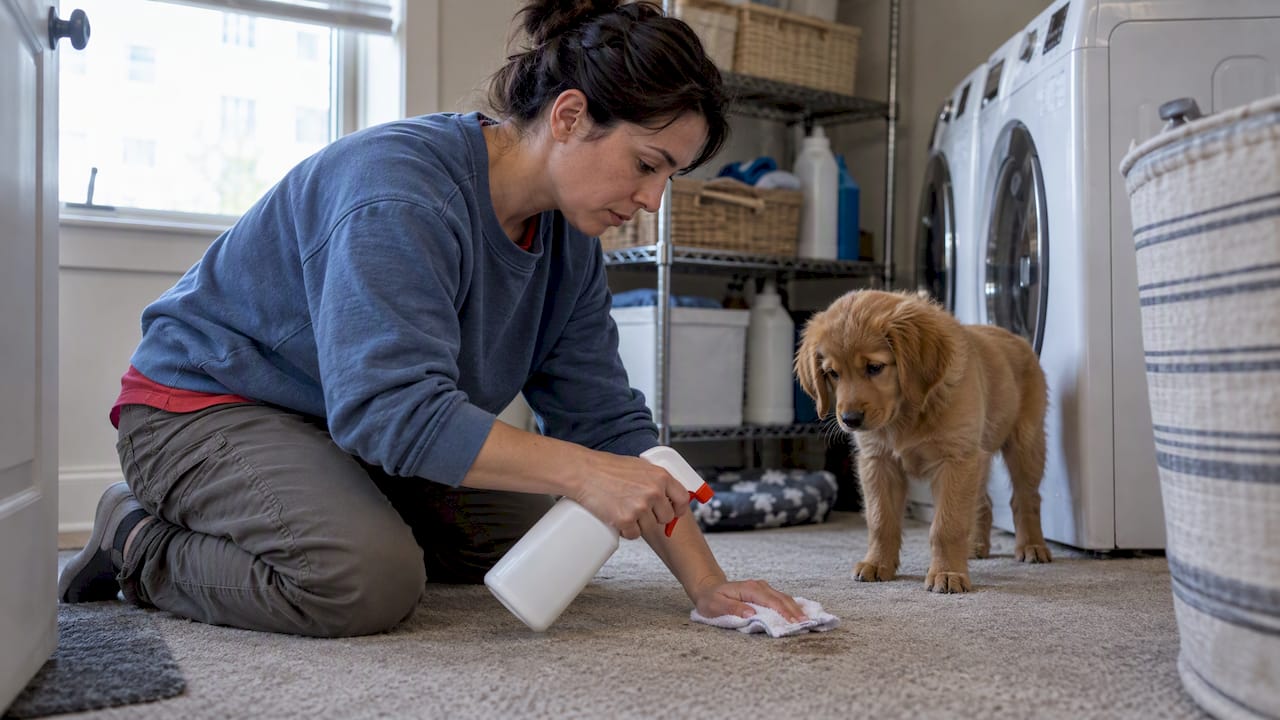
One conversation with a professional at adoption time measurably improved outcomes, according to that same JAVMA research, largely by steering owners away from punishment and toward proper cleanup and scheduling.
When accidents keep happening, run through this checklist:
- Rule out a urinary tract infection or other medical cause with your vet.
- Tighten the schedule back to hourly trips for a few days.
- Check crate size; a crate that is too large lets a puppy soil one end and sleep in the other.
- For small breeds, expect smaller bladders and shorter intervals even as they mature.
- In multi-dog households, separate a puppy in training from housemates during unsupervised stretches so nobody’s habits rub off.
Nighttime regressions often mean a growth spurt or a schedule that has not kept pace with age. Add one middle-of-the-night trip back in rather than assuming it is a step backward.
The Role of Puppy Classes and Socialization
Structured socialization shapes far more than manners. UC Davis veterinary guidance recommends starting exposure to new people, sounds, and environments as early as 3 to 5 weeks and continuing through roughly 12 to 20 weeks, a window tied to calmer adult behavior and fewer training setbacks.
Good puppy classes do double duty:
- They teach owners reward-based timing and handling, not just commands for puppies.
- They expose puppies to new surfaces and distractions that mimic real potty situations away from home.
- They give new owners a chance to troubleshoot schedule problems with an instructor in real time.
Talk to your vet about class timing around your puppy’s vaccination schedule. Many reputable classes accept partially vaccinated puppies in controlled indoor settings, balancing infection risk against the value of early learning.
When to Call a Veterinarian or Behavior Professional
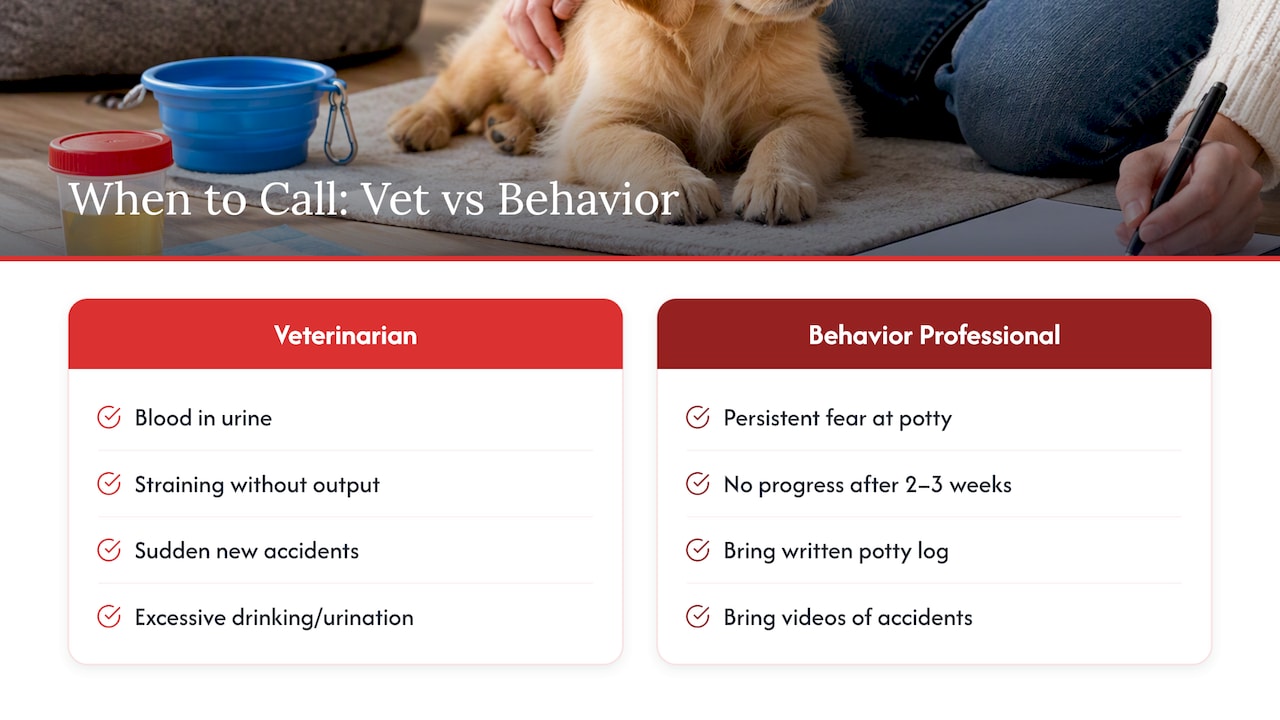
Blood in the urine, straining without producing anything, sudden accidents after weeks of reliability, or drinking and urinating far more than usual are medical red flags that need same-week veterinary attention. A trusted resource like Animal Care of Hobe Sound can help rule out infection or other causes.
Persistent fearfulness around potty trips or no progress after two to three weeks of a tightened schedule points toward a behavior consult instead. Bring a written potty log, a few videos of accidents in progress, and a list of any medications to speed up the diagnosis.
What the Research Actually Supports
The strongest evidence behind this approach comes from a handful of specific findings rather than general wisdom.
- Brief preadoption counseling raises house-training success and cuts punishment use, per JAVMA.
- Enzymatic cleaners remove the odor cues that provoke repeat soiling in the same spot.
- Socialization completed before roughly 20 weeks, as described in UC Davis guidance, supports calmer puppies who pick up routines faster.
Applied together, a schedule, prevention, and early education form a system, not three separate tips.
A Few Honest Words on Patience
Every puppy has an accident after weeks of doing everything right, and that is normal, not failure. Consistency across two weeks teaches a habit faster than any single trick. Try the schedule above for fourteen days and see what changes in your house. For more on keeping routines steady even when life gets busy, our vacation tips for pet owners cover how to protect training progress on the road.
— Brian
Quick Links: Research and Printable Schedules
For the studies behind this guide, see the JAVMA preadoption counseling research and Penn Vet’s housetraining tips, both useful for building your own printable schedule.
Sources
- Effects of preadoption counseling for owners on house-training success among dogs acquired from shelters (JAVMA)
- Puppy socialization guidance (UC Davis / veterinary literature)
- Tips on housetraining your dog (Penn Vet)
FAQ
What is the 10-10-10 rule for puppies?
The 10-10-10 rule gives a puppy 10 minutes in a calm outdoor potty spot, up to 10 tries in that same designated zone, and 10 minutes of close indoor supervision afterward before any freedom. It structures the highest-risk moments of the day so accidents are easier to prevent and catch.
What is the quickest way to potty train a puppy?
The fastest results come from combining a tight, age-based schedule with constant supervision or crating and rewarding successful outdoor trips within two to three seconds. Skipping any one of those three pieces tends to slow progress noticeably.
At what age should a puppy be potty trained?
Most puppies show real progress within a few weeks of starting and become largely reliable between four and six months old, though full consistency can take longer for smaller breeds. Starting the schedule as early as 8 weeks, alongside socialization recommended by UC Davis, tends to produce steadier results.
What is the 10 10 10 rule for potty training?
It is the same routine described above: a short outdoor window, a consistent potty spot, and a supervised indoor period right after, repeated throughout the day. Owners often use it most intensively during the first few weeks before stretching the intervals as the puppy matures.